The most important points briefly
- Whistleblower systems are confidential channels for reporting misconduct and breaches of regulations.
- Companies with more than 50 employees are legally obligated to implement a compliant system – since December 17, 2023.
- Digital whistleblower systems offer the highest security standards, allow for anonymous reporting, and protect whistleblowers from retaliation.
- You foster a transparent company culture, strengthen trust, and serve as an effective early warning system.
- The legal bases are the EU Whistleblower Directive 2019/1937 and the German Whistleblower Protection Act (HinSchG).
Definition: What is a whistleblower system?
A Whistleblower system – also known as a whistleblower system – is a structured instrument that companies, organisations and authorities use to support internal or external whistleblowers in reporting grievances such as corruption, discrimination, data protection violations, environmental offences or other compliance violations. This is done within a protected framework where the identity and content of the report are treated confidentially and are legally protected.
The aim is to avert harm to the company, its employees and the public through early information. Modern Whistleblower schemes go beyond simple reporting channels: they offer structured workflows, secure communication, deadline management and legal documentation.
The legal obligation to introduce arises from:
- the EU Directive 2019/1937 on the protection of persons who report breaches of Union law
- the Whistleblower Protection Act (HinSchG), which transposes this directive into national law
- the Supply Chain Due Diligence Act, which obliges companies to introduce a so-called complaints procedure.
LegalTegrity's whistleblower system is made and hosted in Germany: German technology, adhering to the highest security standards and data protection requirements. The Open Telekom Cloud is ISO 27001 certified.
Those who already protect themselves successfully with LegalTegrity:
Who needs a whistleblower system?
Companies with fewer than 50 employees
Companies below this threshold are only obliged to set up a whistleblowing system in specific cases – for example, if they operate in sensitive sectors or are subject to money laundering legislation. In addition, there may be regulatory requirements that necessitate an internal complaints system. In such cases, sector-specific solutions, such as ombudsman offices of the chambers, may be applicable.
Companies with 50 or more employees
Since 17 December 2023, all companies with 50 or more employees have been obliged to set up an internal whistleblowing system. For companies with more than 250 employees, this obligation has applied since 2 July 2023. Authorities, public institutions, as well as cities and municipalities with a population of 10,000 or more are also affected.
Requirements for a legally compliant system
- Acknowledgement of receipt The receipt of the report must be acknowledged to the whistleblower within 7 calendar days of its receipt. This will ensure that the whistleblower knows their report has been registered and is being processed.
- Reporting options: The system must offer at least two reporting channels – written (e.g. online form or email) and oral (e.g. telephone or voice input). In addition, a face-to-face meeting must be possible upon request. Language barriers should be taken into account, especially for companies operating internationally.
- Information about measures Within 3 months of receiving the report, the whistleblower must be provided with feedback on the planned or already taken follow-up measures. Appropriate documentation of the steps taken to handle the case is mandatory.
- Anonymity Although an anonymous report is not legally mandatory, it is expressly recommended. A system that allows anonymous tips while simultaneously maintaining confidential communication (e.g. via an anonymised chat) significantly lowers the barrier for whistleblowers.
- ConfidentialityThe protection of the whistleblower's identity and that of other persons involved must be guaranteed at all times. Only authorised persons may have access to the reports and their processing. The technical implementation must take this claim to protection into account (e.g. through role-based access, secure authentication, encryption).
- GDPR Compliance: All processing steps – from receipt and storage to data deletion – must comply with the requirements of the General Data Protection Regulation (GDPR). This particularly affects data security, purpose limitation, data minimisation, and the rights of the data subjects to access and erasure. The server location should be within the EU to avoid compromising the protection of the whistleblower and to ensure that data protection policies are not violated.
- Logging and documentation: All notifications and associated processing steps must be documented in a traceable, audit-proof and data protection-compliant manner. This documentation must be kept for at least three years but may be stored for longer in individual cases if necessary to fulfil legal obligations.

What types of whistleblower systems are there?
Letterbox
This simplest form of reporting channel is not suitable for meeting the requirements of the Whistleblower Protection Act. It neither allows for secure communication nor anonymity or follow-up questions. Furthermore, data protection is not guaranteed.
Email inbox
Setup and use are straightforward. However, there are high risks of data protection breaches: access by IT personnel, storage on non-European servers, or a lack of encryption can have serious consequences. Enquiries to whistleblowers are also usually not possible anonymously.
Telephone Hotline / Call Centre
While telephone reporting channels offer direct communication, many whistleblowers find direct conversations uncomfortable. Language barriers, unclear conversation management, and a lack of documentation complicate the process. Furthermore, accessibility outside of office hours is usually not provided.
Ombudsperson
An ombudsperson – whether internal or external – can receive, document and forward tips. While this is a legally compliant solution, it is costly, person-dependent and relies on trust. A combination with a digital reporting system is particularly suitable.
Digital whistleblowing systems
Digital platforms allow whistleblowers to submit reports anytime and from anywhere – securely, anonymously, and transparently. They offer standardised processes, real-time communication (e.g. chat function), deadline monitoring and GDPR-compliant data storage on European servers. These systems are considered the most reliable, scalable, and user-friendly solution for companies of all sizes.
Analogue Solutions: Strengths and Weaknesses of Proven Classics
The Task from reporting channels, it is, Anonymous and confidential communication to enable a whistleblower and a company. Crucially, it is not just about receiving tips of misconduct or legal violations. If a company wants to use these tips to take action internally and avoid greater damage, additional information is often required. This information can only be obtained by asking the whistleblower for clarification.
| Advantages | Disadvantages | |
| Letterbox |
|
|
| Call centre |
|
|
| Compliance Officer or Ombudsman |
|
|

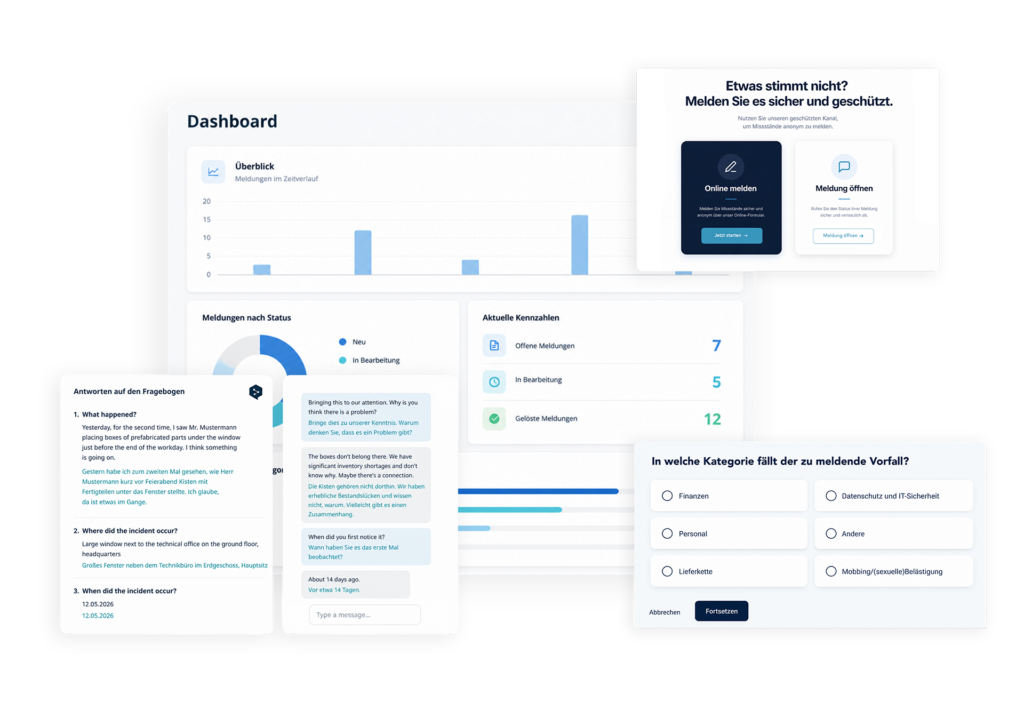
Learn in 5 minutes
Before you book a live demo appointment with LegalTegrity, you can get to know our software in just 5 minutes. Request our demo video to get an overview of all the system's important features and customisation options. You will receive the demo video via email.
Digital whistleblowing systems: process and benefits at a glance
Digital whistleblower systems allow employees, business partners or external third parties to submit tips in a structured, anonymous and secure manner. The entire process is designed for confidentiality, legal certainty and traceability – regardless of whether it is a small business or an international corporation.
Below you can see how a typical reporting process runs
- Incident observation
An employee, supplier, or business partner observes behaviour that violates laws, internal regulations, or ethical standards. - Submission of the report
Information can be submitted anonymously or by name via a web-based portal. Documents, images or further evidence can optionally be uploaded. Modern systems automatically remove metadata from the files. - Acknowledgement and Processing
The system automatically confirms receipt within the statutory timeframe and forwards the report to the responsible department (e.g. Compliance department or external ombudsman). - Anonymous Dialogue
The relevant department can ask follow-up questions to the whistleblower via a secure chat function, even anonymously. This significantly improves the quality of processing. - Decision on consequences
Following a legal review, a decision will be made regarding internal measures or legal action. All steps will be documented by the system. - Follow-up and conclusion
The whistleblower will receive feedback on the measures taken within 3 months at the latest. The system automatically reminds them to comply with this deadline.
Advantages of a digital whistleblowing system
Legal certainty
Complies with all requirements from the EU Directive and HinSchG.
Staff protection
Anonymous reporting without fear of consequences.
Cost savings
Reduces potential fines and litigation.
Scalability
Suitable for small businesses as well as international corporations.
Selection criteria for your whistleblowing system
An effective whistleblowing system must not only comply with the law but also be suited to your company's structure, culture, and technical capabilities. When choosing a suitable system, you should examine the following criteria in detail:
- Company size:
Small and medium-sized enterprises (SMEs) often benefit from standardised, ready-to-use „plug-and-play“ solutions that do not require complex IT implementation. These systems are often designed to be cost-effective and user-friendly. Large companies and international groups, on the other hand, often require scalable systems with advanced features such as multi-language interfaces, differentiated reporting options, and customisable authorisation concepts for different locations or departments. - IT Infrastructure
Companies with limited internal IT resources should opt for so-called SaaS (Software as a Service) solutions, such as LegalTegrity's whistleblower software. These systems run entirely in the cloud, require no installation or maintenance by the company, and can be accessed via a secure web portal. Companies with their own IT department, on the other hand, have the option of integrating systems into existing IT infrastructures, for example, for synchronisation with compliance tools or HR systems. - Availability:
A whistleblowing system must be accessible at all times – regardless of location, time, or device. This is particularly important for companies with shift work, international locations or field services. Mobile optimisation and multilingualism contribute significantly to user-friendliness and increase acceptance within the company. - Data protection and security:
Adhere to the highest security standards, such as end-to-end encryption, two-factor authentication, and role-based access. The server location should ideally be in Germany or at least within the EU to comply with GDPR requirements. Also, check whether the systems are regularly audited or certified (e.g., ISO 27001). - Deadline management
Legally mandated deadlines (e.g., 7-day confirmation, 3-month response) must be reliably met. Digital systems offer significant advantages here: they automatically remind users of outstanding tasks, document status changes in an audit-proof manner, and prevent missed deadlines through proactive escalation mechanisms. - External vs. Internal Processing
Check whether reports should be handled internally by your own compliance or HR department, or whether you want to rely on external ombudsmen or service providers. Internal solutions allow for quick response times, but are more sensitive with regard to data protection and confidentiality. External handlers offer greater objectivity and professional distance – especially in sensitive cases.
A balanced relationship between technical functionality, legal security, and user-friendliness is crucial. Furthermore, the system should be individually adaptable to the company's processes to ensure the smoothest possible integration into existing structures.
Would you like to handle notifications of infringements internally or delegate the handling?
Companies face the decision of whether to handle incoming tips internally or outsource this task to external partners. Both models have advantages and disadvantages – the crucial factor is which approach best suits a company's own structure, corporate culture, and risk assessment.
The options at a glance
External contacts
- An additional external contact point helps to reduce inhibitions.
- Your trusted lawyer or tax advisor, or an external ombudsperson, can help with this.
In-house solution
- Reception and processing by internal person or department
- Requirement: The person should be perceived as trustworthy by both management/company leadership and employees.
Regardless of the chosen solution, a transparent, respectful handling of incoming tips lowers the threshold for reporting. Experience shows that whistleblowers are often willing to reveal themselves in the further course of proceedings – provided they gain the impression that their report is being taken seriously and handled professionally.
Introducing a whistleblowing system: what do you need to consider?
A whistleblowing system is only effective if it is accepted and used by employees. It is not just the technical provision that is crucial, but above all the way in which the system is introduced and communicated. The following steps will help you to build trust and to sustainably embed the system in the company.
Open communication instead of hidden solutions
A common mistake when introducing a new product is to Whistleblower tool Simply linking to the „still“ section of the intranet – without accompanying information – leads to the channel being unused. In the worst case, whistleblowers turn to external parties or the public. On the other hand, open communication signals that feedback is welcome and taken seriously. Therefore, explain early on why the system is being introduced, what reports can be submitted about it, and how the processing works. Codes of conduct, FAQs, or case studies help to reduce uncertainties.
Promoting psychological safety
Whether a lead is reported depends heavily on employees' personal sense of security. Those who fear suffering disadvantages will remain silent. Therefore, it is crucial to clearly communicate whistleblower protection – for example, through assurances of confidentiality, the possibility of anonymous reporting, and protection against reprisals. A lived error culture that focuses on clarification rather than blame also promotes acceptance. Feedback on past reports that were taken seriously can further build trust.
Communication as an ongoing task
The introduction of the whistleblower system is not a one-off project, but must remain permanently present in internal communications. Only in this way will it remain in the awareness of employees and will also be used when needed. In addition to integration into training and onboarding processes, short reminders in team meetings or newsletters are also suitable. It is important not to present the system as a control instrument, but as a contribution to responsibility, fairness, and corporate integrity.
A whistleblowing system doesn't thrive on technology alone – it needs trust, transparency, and clear communication. Those who approach the topic openly from the outset and consider the psychological aspects lay the foundation for a system that works – not just on paper, but in daily corporate life.
Conclusion: Which whistleblowing system is right for your company?
An effective whistleblower system must be oriented towards the reality of your employees. Educational level, language skills, place of work, or cultural barriers significantly influence the willingness to use it. The easier the system is to use and the better it is integrated into existing communication habits, the greater the acceptance.
Digital systems offer crucial advantages: they allow for anonymous reporting from any internet-enabled device, regardless of location. Even employees without office workstations – for instance, those in production or field service – can submit tips quickly and securely. An intuitive user interface in clear language is important here.
In addition, cloud-based platforms automate key legal requirements. Upon receipt of the report, the responsible person is informed, legal deadlines (7-day confirmation, 3-month feedback) are monitored by the system, and communication with the whistleblower is also possible anonymously. At the same time, company-specific questionnaires can be integrated, facilitating targeted follow-up questions.
Particularly attractive for medium-sized businesses without their own IT department: Modern whistleblower systems do not require complex integration. After booking, you will receive individual access that is ready for immediate use. Data processing takes place securely in certified data centres – ideally in Germany.
Whether it's compliance violations, employment law issues, or indications of discrimination – a functioning whistleblower system protects your company, gives employees a safe voice, and shows potential partners and investors that your company takes its responsibilities seriously.
Our recommendation: a cloud-based whistleblowing system
LegalTegrity offers a secure, legally compliant, and ready-to-use platform solution for medium-sized businesses:
- Data storage in the Telekom Cloud (Germany).
- No technical integration required Access via link or QR code.
- User-friendlyNo training required, intuitive operation.
- Legal certainty Automated deadline monitoring and documentation.
- Access only for authorised personnel.
- Trustworthy communication with whistleblowers.
Download our guide „How to implement the Whistleblower Protection Act in your company“ now, or Contact one of our experts for a personal conversation.
FAQ – Frequently Asked Questions
Experience shows that in companies with 1,000 employees, 10 to 13 tips a year can be received – depending on awareness, trust, and company culture.
Scientific studies show: The possibility of anonymous reporting is hardly misused for false reports. Professional processing prevents misuse.
Yes – cloud-based solutions like LegalTegrity in particular require no IT department, are immediately ready for use and scalable.
On the contrary: a transparent system promotes values such as trust, responsibility, and fairness. It shows that companies do not tolerate misconduct.
(The male form used refers to all persons, regardless of gender.)