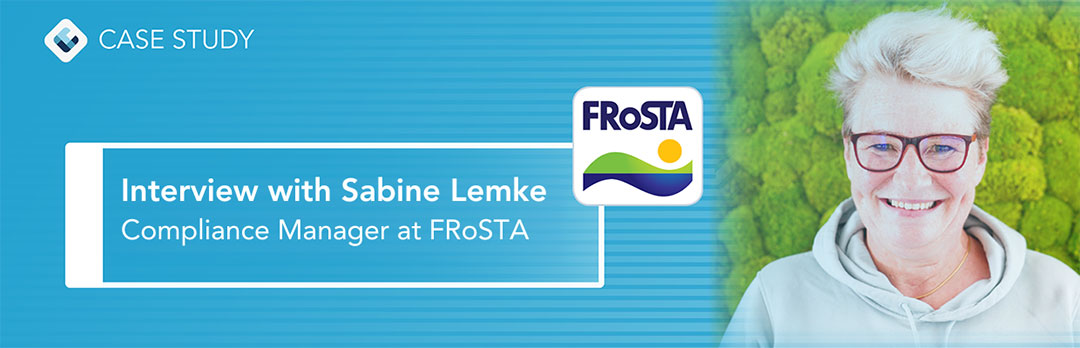
“Both must be guaranteed: protect employees and protect the company FRoSTA.”
Ms Lemke, why did FRoSTA decide to introduce a whistleblowing system?
How did you go about implementing the LegalTegrity whistleblower system?
We first involved the Works Council and the Data Protection Officer. In our case, this was easy, as I am also the Data Protection Officer. In the next step, it was decided that the reports would be handled by me in Germany and by my colleague in Poland. We adopted a Works Agreement, and the templates from LegalTegrity helped us greatly, as we only had to make minor adjustments. We included the QR code to the whistleblower system in our Code of Conduct and also published it on our website.

„We adopted a works agreement, and LegalTegrity's templates were a great help, as we only had to make minor adjustments.“
Sabine Lemke
What do you see as the biggest advantages of a whistleblower system like LegalTegrity?
Primarily, the opportunity to uncover grievances that might otherwise have gone undiscovered. It was important for us to give employees the assurance that complaints are not ignored and that we investigate every single tip. We also rely on this because most things happen “at the grassroots”. Colleagues in production and warehousing are close to the product and have insights that I don't. Of course, compliance with the Whistleblower Protection Act is also essential nowadays, and it was reassuring for me to know that any potential changes in the law are automatically taken into account in the LegalTegrity system. In our case, further regulations also apply, which we comply with using LegalTegrity: we use the tool for compliance with the Supply Chain Due Diligence Act, for which we have been subject to reporting obligations since 01.01.24. Furthermore, as a food manufacturer, we are IFS certified, a food standard. This also requires an anonymous reporting system.
Alongside the technical introduction of the reporting channel, communication within the company is also important. How did you approach the topic of “speak-up culture” at FRoSTA?
We have developed a whole range of communication measures. Starting with a poster, which we physically hung up in all our branches and ran digitally on our screens. This poster is available in four languages, and can be easily scanned with a QR code. Again, the templates from LegalTegrity were helpful in its creation. A large number of our colleagues work in production. There, too, the poster is displayed on screens. The “Tone from the Top” was very important to us. Our CEO Felix Ahlers recorded a video about the whistleblower system, which we also published through all available channels, such as our intranet. The whistleblower system is an integral part of the onboarding plan for new employees. New applicants are also informed about it.
Do you receive many tips?
When we introduced the system, it was noticed that many things were reported to test: Does it work? Is it truly anonymous? Since then, fewer tips have come in, most of them relating to relevant issues. We have been able to uncover some things and adapt processes accordingly. Currently, things are relatively quiet, so we are planning new communication measures. It is important to remind employees of the system regularly.
Are primarily legally relevant notices issued? Or do you also receive other types of “expressions of displeasure”?
Complaints are also made, but this changes over time. We point out in training sessions and via the intranet what compliance-relevant cases are, and as a result, the reports are becoming increasingly significant. Nevertheless, even reports that don't seem particularly relevant at first glance may provide valuable insights into the mood within the company. Like a kind of barometer.
How do you manage the follow-up of relevant leads? Do you go it alone?
It is often necessary, for example, to involve supervisors and hold discussions. We proceed alone as far as necessary, but ultimately certain individuals almost always have to be included. We are careful not to mention names and only describe facts. This ensures that confidentiality is maintained. Both must always be guaranteed: protecting employees and protecting the FRoSTA company.
Did anything not go ideally in the process? What might you do differently from today's perspective?
I would involve more employees in the introduction process of the reporting channel. Initially, it was often referred to as the “grumbling channel” via “grapevine”. I think this can be avoided by, for example, involving managers more strongly at an early stage.
Have you got a tip on how to clarify the false connotation of “snitching” among employees and build trust in the whistleblowing system?
Show your face. In my case, that means going into production, travelling to other locations, and talking to people. That's how trust is built. Employees then also realise through experience that we take suggestions seriously and treat them confidentially. Another important factor is that senior management must back this. That is the most important thing with all compliance issues.
Thank you very much, Ms Lemke!
Our next free webinar for you:
We regularly offer exciting webinars on the subject of whistleblowing.
Customers, partners, and experts engage in dialogue with us and you here, sharing insights and expertise on whistleblowing related to supply chains, ESG & sustainability, employment law, data protection, and more.
Register for our next webinar now!